By Adel Darwish
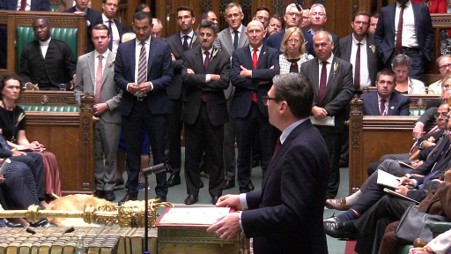
Andy Burnham’s second Prime Minister’s Questions produced a sentence which may prove more revealing about his premiership than he intended.
Challenged by Kemi Badenoch over defence spending, he insisted that Britain must support its national security, “but it can’t come at the expense of social security”.
It was a very Burnham answer. A question about defence had somehow arrived at housing, homelessness and the pressures facing families. It also raised eyebrows around Westminster. Armies, missiles and intelligence services cannot normally be financed with good intentions about social cohesion.
But there was an intriguing echo from another Labour government, 57 years ago.
On 5 March 1969, Denis Healey, then Defence Secretary, confronted Labour colleagues demanding further reductions in military expenditure. His warning could hardly have been more different from Burnham’s:
“I warn my honourable friends… that once we cut defence expenditure to the extent where our security is imperilled, we have no houses, we have no hospitals, we have no schools. We have a heap of cinders.”
Healey was not arguing that social spending did not matter. He was arguing about sequence. Without national security, ultimately there could be no social security.
Burnham turns the proposition around. National security, he argues, cannot be purchased by impoverishing the society it is intended to defend.
Both propositions contain an uncomfortable truth.
And the similarities between 1969 and 2026 go rather further than a convenient quotation from Hansard.
Healey’s warning came from a Labour government wrestling with a strangely familiar world. After the Six-Day War of 1967 Britain was accused on the region’s streets of siding with Israel, while British diplomacy was helping to frame the settlement eventually embodied in the British-drafted UN Security Council Resolution 242. At home, Labour MPs were pressing for social expenditure to be protected as defence commitments were cut; abroad the decision to withdraw east of Suez was resisted by Gulf rulers who feared the security vacuum Britain would leave behind. More than half a century later, another Labour government is again balancing defence against social spending, confronting Israeli-Palestinian diplomacy, while Gulf states seek to preserve, and revive, a different architecture of regional accommodation through the Abraham Accords.
Behind all three lay a question which has never entirely disappeared: what sort of international power does Britain wish to remain, and how much is the British taxpayer prepared to pay for it?
More than half a century later, another Labour Prime Minister is discovering that the question survives.
Russia’s war against Ukraine, doubts about America’s long-term willingness to carry a disproportionate share of European defence, and Britain’s own military commitments have returned defence expenditure to the centre of politics. Yet Burnham leads a government simultaneously promising more homes and confronting pressures on welfare and public services.
Hence his attempt to redefine security.
The security of the state and the security of the citizen, in Burnham’s argument, cannot simply be placed on opposite sides of the Treasury ledger.
The difficulty is that eventually the Treasury does precisely that.
And, just as in Healey’s time, the Middle East has intruded into the argument.
Burnham returned to the government front bench this week beside Ed Miliband as ministers defended new economic measures against Israeli settlements in the territories Britain calls the West Bank. These include restrictions affecting settlement goods and measures aimed at companies financing or facilitating settlement construction.
The Government presents them as measures to uphold international law and preserve the possibility of a two-state settlement.
That is a legitimate foreign-policy position. But governments do not make foreign policy in an electoral vacuum.
That applies in London. It also applies in Jerusalem.
For Burnham there is an immediate domestic complication: Holborn and St Pancras, Sir Keir Starmer’s former constituency, where the 8 October by-election provides one of the earliest electoral tests of the new premiership.
Gaza matters there.
Labour faces a Green Party increasingly willing to challenge it from the left-over Israel and Palestinian rights. The constituency contains a substantial student population and, even before the by-election, had demonstrated that there were voters prepared to desert Labour over Gaza.
Labour’s choice of candidate has hardly made an awkward contest easier. What should normally have been the relatively straightforward inheritance of a former Labour Prime Minister’s seat has acquired an uncertainty which Downing Street would be foolish to ignore. Sagal Abdi-Wali is unquestionably local and experienced, although having become leader of Camden Council only three months ago, her immediate move towards Westminster may leave some voters wondering how long a mandate to serve locally was intended to last. But local party members and the wider electorate are not necessarily the same constituency. Holborn and St Pancras spans student districts, social housing and prosperous professional neighbourhoods; a candidate attractive to a highly organised local membership may not automatically replicate Starmer’s broader coalition of voters.
It would be equally foolish to claim, without evidence, that Burnham’s Government devised its settlement policy merely to influence one London by-election. Some measures predate the contest and ministers can reasonably argue that they arise from established policy and international law.
But in democracies, foreign policy and electoral politics do not inhabit separate universes.
Economic punishment of settlements sends a much more tangible political signal than another ministerial repetition of support for a two-state solution. Ministers know perfectly well which voters will hear it.
The sanctions are aimed at settlements several thousand miles away. Their first electoral test may come rather closer to Downing Street.
Yet the same democratic calculation which applies in Holborn and St Pancras applies inside Israel.
British and other Western governments may hope that diplomatic and economic pressure will restrain Benjamin Netanyahu’s government, discourage settlement expansion or strengthen more moderate Israeli opinion.
It can produce the opposite result.
Pressure perceived by Israeli voters as foreign punishment can strengthen precisely those politicians Britain would prefer to weaken. Netanyahu and parties further to his right require little encouragement to portray outside criticism as evidence that Israel is being singled out or abandoned by supposed allies.
That problem became considerably more acute after the Hamas attacks of 7 October 2023.
Whatever constituency existed inside Israel for exchanging territory for peace was badly damaged by the attacks. Israelis who strongly oppose Netanyahu, and may also oppose settlement expansion, do not necessarily draw from 7 October the conclusion favoured in many Western capitals: that the answer is an accelerated path towards a Palestinian state.
Some draw precisely the opposite conclusion.
Nor is the democratic problem confined to Israel. Western diplomats contemplating Palestinian elections face another uncomfortable possibility: what if an election produces a result they do not like?
Tom Tugendhat, the shadow Foreign Secretary, raised an even more awkward consequence with Ed Miliband in the Commons. Britain has now recognised the State of Palestine; Hamas remains a proscribed terrorist organisation. What happens if future Palestinian elections produce a Hamas government? Would Britain recognise the government of a state it already recognises if that government were controlled by an organisation it proscribes; and what would happen when its representatives sought diplomatic recognition in London?
Miliband did not resolve that contradiction. Yet it is hardly theoretical. Diplomats from several countries privately express concern that genuinely competitive Palestinian elections could produce a Hamas victory, whether through ideological support, organisation, disillusionment with its opponents or intimidation.
Democracy is rather inconvenient in that way. Electorates are under no obligation to produce the government foreign ministries would prefer.
This is sometimes missed when governments in the MENA region calculate how to deal with Israel. Israel is frequently analysed primarily through military strength, American backing, intelligence capability and the intentions of whichever coalition happens to be governing.
But Israel is also an electoral democracy, with all the inconveniences that entails: multiple parties, coalitions, public opinion, opposition, an independent judiciary capable of challenging government decisions, and a press which the government does not control. Politicians therefore calculate not only what foreign governments demand, but what domestic institutions and voters will tolerate.
A concession which appears perfectly rational to a foreign government may be electoral suicide for an Israeli minister. Conversely, an act which appears diplomatically self-defeating abroad may be politically rewarding at home.
Western governments can make the same mistake when dealing with the region, assuming that governments can simply deliver populations whose attitudes, fears and political pressures may be rather different from those represented around a diplomatic table.
Foreign policy therefore has two audiences: the foreign government at which it is ostensibly directed and the domestic electorate watching from home.
Sometimes there is a third: the electorate of the country being pressured.
That is why this week’s apparently separate Burnham stories are not really separate at all.
At PMQs he was trying to reconcile defence commitments abroad with social obligations at home. On Israel, he is trying to influence events abroad while governing amid political pressures at home and dealing with another democracy whose government is responding to pressures of its own.
Healey understood the first dilemma in 1969 because he was living through Britain’s retreat from commitments accumulated when the country possessed greater resources and a very different global position.
His “heap of cinders” remains the brutal answer to anyone pretending that defence is merely another optional department competing for Treasury money. Houses, hospitals and schools are not much use if the state cannot protect them.
Burnham’s answer is that the reverse also matters. A country whose citizens cannot find homes, whose public services deteriorate and whose communities lose confidence in government may possess weapons while becoming less resilient as a society.
The argument between the two Labour politicians, separated by 57 years, is therefore less about which one was right than about the permanent difficulty of governing.
Security has a military price, a social price and, eventually, an electoral price.
And this week Burnham has been discovering all three, or may yet discover whether its selection process listened more closely to the people who attend party meetings than to those who merely turn up on polling day.
–