Category Archives: Government

Rachel from Accounts and the Death of Labour’s Soul

By Adel Darwish

There was a time when the Labour Party could summon idealists, intellectuals, and political giants from the pavements of Britain. The Fabian Society debated the future of civilisation, not the future price of printer toner. Its members wrote books, not bullet points; they dealt in ideas, not invoices. They spoke of building a better world, not balancing the petty cash drawer. Today, the party’s intellectual inheritance has been pawned for a stack of spreadsheets, and its ideological flame entrusted to a woman we now know, affectionately and despairingly, as Rachel from Accounts.

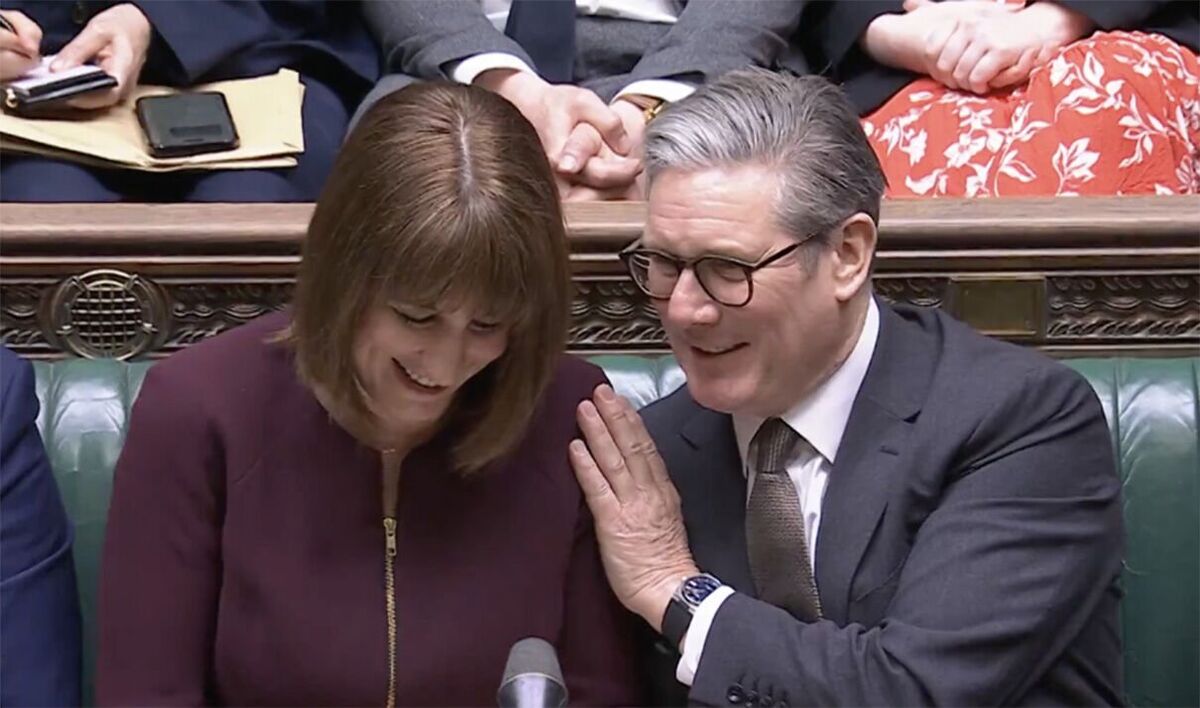
(The Express picture)

Political nicknames rarely land with such devastating accuracy. This one encapsulates not merely her demeanour but her method: the belief that government is a question of reconciled columns rather than reconciled ambitions. The Budget she delivered on Wednesday did not feel like a national plan. It felt like an internal memo leaked from an HR director defending cuts to the biscuits fund. And yet this is the moment Labour promised would herald a “new era” — a Britain rejuvenated, reenergised, and ready to lead. Instead, Rachel Reeves produced the long talked about written with the emotional range of a procurement manual. It wasn’t a Budget; it was a defibrillator applied to the dying political career of Sir Keir Starmer. It bought him time, nothing more. The economy was merely the collateral.

Let us be clear: Reeves did not govern — she bargained. Her primary audience was not Britain but Labour’s backbenches. The Budget was one long bribe disguised as fiscal discipline, designed to placate the party’s left flank, who, having mistaken slogans for policy, now regard taxation as a sacrament and aspiration as a sin. Seven Labour MPs already had the whip withdrawn for rebelling over the two-child benefit policy, only for a U-turn this week; this Budget was the ransom note required to forestall further mutiny.

Meanwhile, Starmer, a man increasingly resembling a hostage reading demands under duress, watched his Chancellor hack away at the country in order to keep the party intact. It is governance in reverse: the Starmer-Reevs regime survives, the nation pays.

Reeves’s media round the morning after confirmed what the Opposition, economists, and even cheery breakfast presenters warned all along: Labour’s election promises were fantasy. Reeves was repeatedly challenged on the simple arithmetic she once dismissed as cynicism. Freezing the income tax threshold at £12,570, she insisted, was not a tax rise. This was a heroic attempt to redefine the English language. Independent think tanks note the threshold freeze will leave families on around £35,000 a year £1,400 worse off — a hit far larger than a modest 1p or 2p rise in income tax would have delivered. In other words, Reeves has achieved the political miracle of taxing the many more painfully than taxing the few.

Then came the leaks — a farce that would embarrass a parish council, let alone the Treasury. Reeves held a Budget press conference two weeks early, despite the long-standing, near-sacred principle of Budget secrecy. Shadow Chancellor Mel Stride pointed out, with barely suppressed disbelief, that releasing market-sensitive fiscal measures ahead of time isn’t merely foolish — it is potentially illegal. Even the Deputy Speaker rebuked her, an act as rare in Parliament as a unicorn sighting.

And then the crowning humiliation: the Office for Budget Responsibility uploaded the entire Budget online forty minutes before she spoke. It vanished shortly thereafter, but the damage was done. Reeves stood at the Despatch Box like someone gamely reading out a surprise party invitation that had already been tweeted by the venue. Ministers once resigned for less. Reeves shrugged.

For context, when Hugh Dalton whispered a few Budget titbits to a journalist while walking into the Commons in 1947, he resigned the next day. When Jimmy Thomas leaked the Budget proposals in 1936, he left the Cabinet and public life. Reeves did not merely whisper; she broadcast — and yet she remains, the beneficiary of a political age that has forgotten what shame feels like.

But the true scandal is not procedure; it is purpose. Labour has raised £26 billion in taxes without allocating a penny to growth. Not a farthing for productivity. Nothing for enterprise. No relief for the industries crippled by the Net Zero policy. Reeves has built a fiscal fortress without an exit — a country where money circulates but does not multiply, where public services are funded but no wealth is created to sustain them.

Consider the property tax raid: heralded as a strike against the idle wealthy, it raises just £400 million — scarcely 1.5% of the total tax take. A drop in the Red Sea. Yet its ideological purpose is vast. It punishes those who are not deemed “working people” — the retired, landlords, homeowners who have saved rather than spent. These individuals will now either increase rents, worsening the housing crisis, or sell assets, withdrawing supply entirely. Schools, orphanages, and hospices with buildings worth more than this arbitrary threshold could be caught in the crossfire. Reeves has taxed philanthropy and called it justice.

Meanwhile, the wealth creators Labour insists have nowhere else to go have, in fact, gone. 10,800 millionaires left the UK in 2024 — many of them business owners and investors. The Adam Smith Institute calculates that replacing the tax contribution of a single millionaire requires 49 ordinary taxpayers. Reeves has effectively exported the fiscal equivalent of the population of Manchester. Britain has become the world’s only country where you are free to make money, provided you do it somewhere else.

Here lies the eulogy for Labour’s soul. The party of Attlee and Bevan sought to expand opportunity; the party of Reeves and Starmer seeks to itemise it. Old Labour asked how to build a future. New Labour asks how to fund yesterday. The Fabians once dreamed of progress. Rachel from Accounts dreams of a tidy balance sheet.

She has not crashed the economy. She has audited it into paralysis.

And the irony? The only growth Labour has delivered is in political nicknames. Reeves may yet go down in history not as Britain’s first female Chancellor but as the woman who proved that when you run a country like a spreadsheet, you eventually discover the nation has clicked “Delete” — and moved abroad.

End

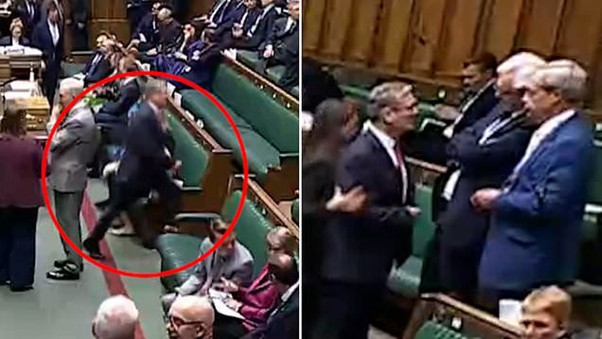
Starmer’s Conference: More Farage Than Future

Keir Starmer used Labour’s biggest stage not to set out a vision but to attack Nigel Farage—granting his rival the oxygen of free publicity. By Adel Darwish

The Labour Party’s annual conference this year was meant to be a decisive moment, a chance to remind its members, supporters and the wider electorate that Labour is ready to govern. Instead, it closed with more disappointment than inspiration. Speeches by party leaders are usually designed to be rallying cries, moments of energy that fire up activists and volunteers and arm them with a clear narrative to take to the doorstep. Keir Starmer, however, chose to spend the bulk of his address not outlining Labour’s vision for Britain but attacking Reform UK and its leader, Nigel Farage. In doing so, he handed his rival the one thing every politician craves—free publicity on the biggest stage available to Labour.

Nor was it only Starmer who fell into this trap. Several of his cabinet colleagues followed his lead, devoting large sections of their own speeches to attacks on Farage. The effect was to shift the image of the conference away from a confident party showcasing its programme of government, towards the spectacle of an anxious leadership rattled by a challenger advancing fast in the polls. It was an error of tone and judgement that made Labour look reactive rather than authoritative.

Alongside these speeches came policy announcements that seemed tailored more to mimic Reform’s rhetoric than to present Labour’s original ideas. Tougher migration policies were unveiled, including extending the waiting period before long-term visa holders can apply for British citizenship. These were clearly designed to signal that Labour, too, could be firm on immigration. Yet the question inevitably arises: will the public believe these are born of genuine conviction, or dismiss them as panicked reactions to Farage’s rise?

The polling numbers paint a sobering picture. Reform UK is projected to be ahead by between 100 and 170 seats in the next parliament, a gap that looks less like a swing of the pendulum and more like a landslide in waiting. Inside Labour itself, discontent is spreading: 54% of members want Starmer to go, while 34% of the party’s own MPs are also reported to favour his replacement. These are not marginal murmurs of dissent but signs of a party that no longer trusts its leader.

Starmer’s response to these pressures—attacking Farage harder and borrowing parts of his agenda—seems doomed to fail. Voters are unlikely to reward imitation. They may reasonably ask: why support a leader who shifts position under pressure, when they could vote for the original brand? By pursuing this path, Starmer risks strengthening Farage’s legitimacy instead of undermining it.

The deeper danger lies in what this conference says about Labour’s identity. Instead of presenting itself as the natural party of government, ready to step in after years of Conservative turmoil, Labour came across as nervous, uninspired and lacking in courage. The stage that should have projected authority and vision was reduced to a platform for settling scores with a rising rival.

What Labour urgently needs is not reactionary mimicry but authenticity: bold, convincing policies that feel rooted in its own values and a narrative that inspires confidence. It requires a leadership capable of finding a language (not just to scare the electorate of  Reform), reflecting the hopes of ordinary Britons. Until that happens, Farage and his party will continue to fill the vacuum, gathering strength in both public opinion and parliamentary projections. Starmer, meanwhile, will go on squandering chances—perhaps the last chances—for Labour to reassert itself as a credible alternative government.

FCDO minister Wendy Morton in Evidence Session 13 July

Foreign and Commonwealth Office ( and international development) minister, Wendy Morton, (who is undersecretary of state for foreign affairs), is expected to give evidence on Tuesday 13 July (13:30 GMT) to the Foreign Affairs Committee, as the final evidence session in the committee inquiry into global health security.

The session is the final one a series of sessions that started in March this year and was followed on 30 April and 22 June as part of the committee inquiry into global health security.

Those participants are:  

  • Wendy Morton – Minister for European Neighbourhood and the Americas, FCDO
  • Darren Welch – Director of Global Health, FCDO
  • Robert Tinline – Director for Covid-19, FCDO

The Committee is expected to discuss the lessons learnt from the Covid-19 pandemic, and the prospects of reform to the World Health Organisation (WHO) following criticism of its handling of the pandemic. The session will likely cover the impact of the merger between the Department for International Development (DFID) and the Foreign & Commonwealth Office (FCO), and recent aid cuts. Additionally, the Committee is likely to explore concerns over disinformation and vaccine diplomacy, particularly in relation to Russia and China. The Committee will hear from Minister Wendy Morton, and officials Rob Tinline and Darren Welch.

Wendy Morton is the Minister for European Neighbourhood and the Americas at the Foreign, Commonwealth & Development Office (FCDO). Her responsibilities include health, global health security, multilateral health organisations including the WHO, and international organisations such as the Global Fund and GAVI. Wendy was appointed as a Parliamentary Under-Secretary of State in the FCO and DFID in February 2020. She was elected as an MP in 2015.

Tom Tugendhat (Chair) (Tonbridge and Malling), Conservative; Chris Bryant (Rhondda), Labour; Neil Coyle (Bermondsey and Old Southwark), Labour; Alicia Kearns (Rutland and Melton), Conservative; Stewart Malcolm McDonald (Glasgow South), Scottish National Party; Andrew Rosindell (Romford), Conservative; Bob Seely (Isle of Wight), Conservative; Henry Smith (Crawley), Conservative; Royston Smith (Southampton, Itchen), Conservative; Graham Stringer (Blackley and Broughton), Labour; Claudia Webbe (Leicester East), Independent.

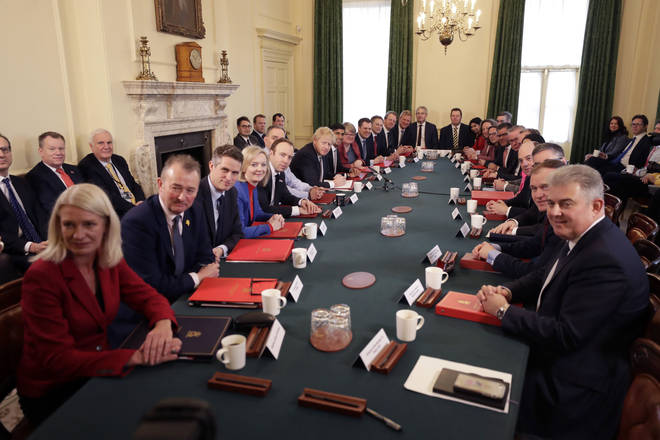
HM Government in Full 2020

Prime Minister Rt Hon Boris Johnson MP, elected December 2019, 365 MPs Majority 44 to pass bills.

Boris Johnson cabinet 14 February 2020

No 10 take more control of the Treasury and other departments. Rising star Rishi Sunak the new Chancellor of the exchequer, Suella Braverman Attorney General, want yo reform Judiciary relationship with westminster, John Whittingdale back in digital media culture and sport  to keep an eye on the BBc and he is a strong believer in Free Speech, former army officer James Cleverly who did a great job as Chairman of the party is now a Min of State at Foreign and Commonwealth Office, will bring fresh experience especially he is jointly in charge of dept of international development.

Government Departments: Continue reading