Category Archives: Energy

The Questions Starmer Would Not Answer

From the Press Gallery, a familiar pattern emerged: precise questions on Mandelson, evasive answers from the Prime Minister, and a growing sense that judgement, not just politics, is now under scrutiny.

By Adel Darwish

From the Press Gallery, certain patterns are becoming increasingly predictable. Prime Minister’s Questions, once an arena of sharp exchange and occasional clarity, now often follows a familiar script: questions asked, answers diverted, and the argument redirected elsewhere. This week, however, the pattern mattered — because it went to the question of judgement at the top of government.

Kemi Badenoch used all six of her allotted questions to focus on the appointment of Peter Mandelson as ambassador to Washington. Drawing on material released under a Humble Address, her questions were structured to test the Prime Minister’s judgement and the basis on which the appointment had been made, and to probe whether his account to the House could be sustained.

Her line of argument was precise: to establish what the Prime Minister knew, what questions he had asked, and how he could now claim that Peter Mandelson had misled him. If, as Starmer suggested, Mandelson had not been truthful about his past association with Jeffrey Epstein, then the obvious question followed: had that issue been put to him directly at the time of the appointment?

The Prime Minister did not engage with that line of questioning. Instead, he repeatedly shifted the exchange onto Badenoch’s stance on the Iran conflict, accusing her of inconsistency and attempting to recast the session as a debate on foreign policy. By his sixth answer, the tone had hardened into outright attack, extending criticism to Reform UK and what he characterised as its proximity to positions he associated with the far right.

The Speaker intervened twice. On the first occasion, he reminded the House that he was not responsible for the Prime Minister’s replies. On the second, the rebuke was sharpened: nor was he responsible for the questions from the Leader of the Opposition. The message was unmistakable — that the exchange was failing to address the substance of what had been asked.

From the gallery, the reason for that pattern was not difficult to discern. The Prime Minister appeared acutely aware of the risks of what he said — and what he chose not to say. Having already faced questions about the Mandelson appointment, his answers at the despatch box now carry potential weight beyond the chamber. With further papers released under a Humble Address, any inconsistency between what he knew at the time and what he told Parliament could invite the most serious accusation in Westminster: that of having misled the House. That risk may explain the caution — and, at times, the conspicuous evasiveness — that marked his responses.

The difficulty for Downing Street is that the Mandelson affair is not an isolated embarrassment but a question of judgement. Documents now in the public domain indicate that warnings were raised about the reputational risks of the appointment. Yet the decision went ahead, and has since unravelled with striking speed. The subsequent financial settlement, agreed at £75,000, has reinforced the political impression of a decision taken against advice and corrected only under pressure.

That question of judgement extends beyond personnel into policy, particularly in energy. The latest tensions in the Gulf — including attacks on gas infrastructure, have revived concerns about supply vulnerability at precisely the moment Britain’s domestic capacity has been scaled back. Critics argue that successive governments once drew the opposite lesson from earlier crises, maintaining both a strategic naval presence in the region and a degree of domestic resilience. The current approach, which combines reduced North Sea production with continued reliance on imports, is now being tested under pressure. At such moments, the balance between long-term transition and immediate security becomes less theoretical and more immediate.

In another era, a foreign crisis might have provided political cover. Governments have often found that external threats rally domestic support and soften internal divisions. This time, the effect has been more limited. While the Prime Minister’s cautious stance on the conflict with Iran broadly reflects public sentiment, it has not translated into any discernible political dividend. Nor has it eased strategic uncertainty. Britain’s role in the region appears more constrained than in previous decades, when a quieter but consistent naval presence helped secure key shipping routes. The contrast is not merely nostalgic; it raises questions about capability as well as policy.

More troubling for Downing Street is that the pressure is no longer confined to the opposition benches. Within Labour, signs of unease are becoming more visible. Angela Rayner’s recent intervention, widely interpreted as a challenge to elements of the government’s economic direction, has underscored the extent to which internal consensus cannot be taken for granted. At the same time, many Labour MPs have signalled resistance to proposed changes in welfare policy, warning that they may not support measures to curb or freeze benefits. These are not yet coordinated rebellions, but they point to a party that is beginning to test the limits of its own leadership.

Even among Labour-leaning commentators, the tone has shifted. Sympathy for the government’s early difficulties has given way to a more questioning assessment of its choices and priorities. That, perhaps, is the more subtle change. Governments can weather opposition attacks; they find it harder to navigate scepticism from those broadly inclined to support them.

The Prime Minister therefore faces a convergence of pressures: scrutiny over decisions already taken, uncertainty over policies still unfolding, and a party that is no longer entirely aligned behind him. None of these challenges is, in isolation, insurmountable. Together, they form a pattern that is becoming increasingly difficult to dismiss.

In politics, individual missteps can often be contained. Patterns, once established, are far harder to break.

Starmer speaking at a nursery school in Belfast 12 March

Even Hecklers Start Small

After a bruising week in Westminster, the Prime Minister found his most honest audience in a Belfast nursery.

By Adel Darwish 

A prime minister who finds himself aligned with public opinion during a foreign crisis might reasonably expect a little political relief. Keir Starmer’s cautious distancing from the American strikes on Iran reflects the instinct of most British voters, who remain wary of another Middle Eastern war. Yet even this rare moment of alignment has done little to improve the government’s political fortunes.

The latest polling suggests a remarkably stagnant landscape. A seven-poll rolling average published this week places Reform UK on 27.4 per cent, Labour on 19.4, the Conservatives on 17.9, the Greens on 14.9, and the Liberal Democrats on 11.9. Despite rising oil prices and the geopolitical tensions surrounding the Iran conflict, there has been no sudden movement in public opinion. Labour has even edged slightly upward over the week. If higher petrol prices were provoking a backlash against the government, we would expect the opposite: a sharp fall in Labour support and a surge for opposition parties. Instead, the numbers suggest voters currently blame global events rather than domestic policy.

That did not spare Starmer a bruising encounter in the Commons. At Wednesday’s Prime Minister’s Questions, Kemi Badenoch used all six of her allotted questions to focus on fuel prices and the looming prospect of higher fuel duty. With Brent crude fluctuating sharply in response to Middle East tensions, petrol and diesel costs are once again creeping upward. For millions of people outside London, Badenoch argued, driving is not a luxury but a necessity — especially for tradesmen, delivery drivers and small businesses whose vans keep the economy moving.

Starmer attempted to deflect the pressure by attacking the opposition’s stance on Iran, accusing Badenoch of shifting positions and suggesting she had previously called for Britain to support American strikes. The exchange grew increasingly heated. At one point the Speaker intervened to remind the Prime Minister that his task was to answer questions rather than ask them of the Leader of the Opposition.

Fuel prices are not a trivial political issue. Rising oil costs ripple quickly through the economy: transport, food distribution, and ultimately inflation itself. Should the surge in energy prices persist, the Bank of England may hesitate before cutting interest rates, delaying the relief many mortgage holders had hoped for this spring. It is precisely this chain reaction that makes petrol prices such a sensitive political subject.

The government’s response has been to summon oil company representatives to Downing Street. Chancellor Rachel Reeves and Energy Secretary Ed Miliband called the industry in for talks at No.11, warning them against “profiteering” by raising prices at the pump. The Prime Minister’s spokesman said ministers were monitoring the situation closely and hinted that companies could face referral to the competition authorities if evidence of manipulation emerged.

The meeting itself became contentious. Retailers accused ministers of using “inflammatory language” about alleged profiteering, warning that it had led to members of the public abusing staff at petrol stations. Some companies even threatened to boycott the talks unless the government agreed that the opening of the meeting would not be filmed by television cameras.

Yet the week’s most awkward development for Downing Street came not from global oil markets but from Westminster itself. Documents released under parliamentary pressure revealed that officials had warned about the reputational risks of appointing Peter Mandelson as Britain’s ambassador to Washington. Mandelson is no stranger to controversy. During Tony Blair’s government he was twice forced to resign from cabinet — first in 1998 after failing to disclose a £373,000 loan from fellow minister Geoffrey Robinson, and again in 2001 after contacting the Home Office about the passport application of the wealthy Hinduja brothers. His post as ambassador quickly became politically untenable once questions resurfaced about his past association with the convicted sex offender Jeffrey Epstein, an association Mandelson had earlier sought to minimise. Despite those concerns, the appointment went ahead. The saga took another turn when it emerged that Mandelson had sought compensation reportedly exceeding £500,000, before eventually agreeing to a settlement of £75,000 — a figure Downing Street insists represented “good value for money” compared with the potential cost of litigation.

The episode culminated in an unusual moment of contrition. On Thursday, the Prime Minister acknowledged that appointing Mandelson had been a mistake and apologised to victims connected to the Epstein scandal. It was a rare public admission of error from a sitting prime minister, though whether it draws a line under the affair remains to be seen.

At Friday’s lobby briefing, Downing Street declined to elaborate on what lessons the Prime Minister had drawn from the episode, with the spokesman cautioning journalists against speculation until the remaining documents are released.

By then, Starmer had already left Westminster for Belfast, that familiar corner of the kingdom where ministers sometimes find themselves dispatched when the political temperature rises in London. Hilary Benn, the Northern Ireland Secretary, stood dutifully beside him like a silent chaperone. The once formidable Downing Street spin machine of the Blair years, when communications were run by Alastair Campbell with Mandelson advising discreetly in the background, might have handled the optics differently. This week the Prime Minister’s team made a simpler logistical decision: Parliament lobby reporters were left behind and Starmer took questions only from local media in an off-camera informal huddle. After a bruising week in Parliament, the controlled environment was perhaps understandable. A nursery classroom, after all, offers a famously undemanding audience — one unlikely to ask awkward questions about fuel duty, oil prices, or the wisdom of appointing Peter Mandelson.

He took refuge in Belfast, well away from Westminster’s turbulence, and, not insignificantly, from the lobby journalists whose questions had been sharpening throughout the week. There, during a visit to a nursery school, he acknowledged he had made a mistake in appointing Mandelson and apologised to Epstein’s victims. Whether the wider public will be quite so forgiving remains uncertain. While he spoke, several toddlers began crying and fidgeting. “I know… I’m nearly finished,” he reassured them. Westminster instincts, including heckling, it seems, can develop remarkably early.

The Logistics of Power: When War and Oil Markets Converge on the Price of Geography

Signals from Washington D.C., Tehran, Lebanon, and the Strait
By Kate Jones, White House Bureau Chief

Wars are often narrated through explosions, declarations, and fear. In reality, outcomes are decided by quieter forces: logistics, geography, and time.

The unfolding crisis across the Middle East illustrates this principle with unusual clarity. Military movements along the Lebanese border, the strategic signaling emanating from Tehran, and the volatility of global oil markets are all expressions of a single underlying constraint: the movement of supply across geography.

Armies move on logistics. So does the world economy. War planners and oil traders rarely speak the same language, yet strategists from Carl von Clausewitz to Alfred Thayer Mahan understood that power ultimately rests on logistics. On this rare occasion, military conflict involving Iran and global markets converges on the same constraint in parallel. This is one of those moments.

The White House is attempting to reassure markets that the current volatility reflects disruption rather than structural scarcity.

“Under President Trump’s American energy dominance agenda, oil and gas production has hit record highs and prices at the pump had dropped to multi-year lows,” said White House spokeswoman Taylor Rogers in a statement provided today. “President Trump has been clear that these are short-term disruptions. Ultimately, once the military objectives are completed and the Iranian terrorist regime is neutralized, oil and gas prices will drop rapidly again, potentially even lower than before the strikes began. As a result, American families will benefit greatly in the long term.”

Washington has begun exploring several policy options aimed at easing upward pressure on crude prices. Officials have discussed a potential temporary waiver of the Jones Act to allow greater flexibility in transporting crude between U.S. ports, and the administration confirmed that approximately 172 million barrels remain available in the U.S. Strategic Petroleum Reserve. The White House has also signaled a willingness to loosen certain restrictions affecting global supply flows, including allowing greater purchases of Russian crude in global markets, while opening limited new offshore drilling opportunities along the California coast.

In aggregate, however, these incremental policy moves have so far done little to calm markets, where crude prices continue to respond primarily to geopolitical risk surrounding the conflict with Iran and the security of maritime shipping routes. Global demand growth had slowed modestly while supply across major producers continues at historically strong levels, leaving markets structurally well supplied. For United States, the economic backdrop remains relatively strong. Recent data on employment, trade balances, housing activity, and inflation have generally surprised to the upside, with price pressures remaining comparatively contained. Under normal circumstances such macroeconomic signals might anchor market confidence. Instead, geopolitical risk surrounding the conflict with Iran and the security of maritime shipping routes is dominating price behavior in global markets. A timely resolution to the conflict would likely reinforce expectations of continued economic resilience.

Global energy markets are grappling with a different question: how to price a war whose logistical boundaries remain unclear. Volatility is not coming from macro weakness, but from logistics of uncertainty.

The Psychological Threshold: $100 Per Barrel

West Texas Intermediate crude is approaching $100 per barrel, a level traders view as a psychological threshold capable of spilling quickly into equities, inflation expectations, and broader financial volatility. Policymakers therefore face an immediate question: whether the administration is preparing for that level and how it intends to communicate confidence if the threshold is crossed.

Concerns about market stability have already surfaced within the financial system itself. As the Financial Times reported this week, the chief executive of CME Group, Terry Duffy, warned that direct government intervention in oil futures markets could risk a “biblical disaster” by undermining confidence in the mechanisms used to establish global benchmark prices. Speaking to traders at an industry conference, Duffy cautioned that attempts to influence crude prices through derivatives markets could damage the credibility of the pricing system itself. Traders had begun asking who the large sellers in the market were, reflecting growing speculation that governments might attempt to calm prices during wartime volatility.

For traders and policymakers alike, the initial phases of war involve signals, noise, and the pricing of geopolitical risk amid uncertainty about the duration of disruption. Yet the deeper uncertainty lies in the real price of oil determined by the physical movement of supply.

The United States and members of the International Energy Agency have announced the largest releases from global strategic reserves, a record 400 million barrels, intended to stabilize markets. Yet the practical mechanics remain critical: the timing and volume of those releases and the speed at which those barrels can realistically reach global markets.

Energy traders are confronting a logistical paradox. Global oil production continues, but large volumes of supply may effectively remain offline if tankers cannot safely transit key shipping corridors.

Oil that exists but cannot move. War disrupts logistics before it destroys supply. Surplus builds.

When maritime risk increases through naval confrontation, insurance restrictions, or the mere threat of sea mines, missile strikes, or drone attacks, transport slows and storage pressures begin to build across the system. Production continues while shipping stalls, leaving supply stranded in storage or held at terminals awaiting safe passage.

Eventually producers face a stark choice: shut in wells. There is no simple off switch for production without risking damage to equipment. Refineries face similar constraints. Shutting down units abruptly can take days or weeks and may require costly maintenance before operations can resume.

These are complex chemical plants. Reactors cool. Catalysts destabilize. Pressure systems depressurize. Pipelines must be purged. Heaters must be restarted slowly. Safety systems trigger.

Unlike financial markets, the physical energy system cannot simply take a day off.

Markets struggle to price the situation because two critical variables remain unknown: the volume of disruption and the duration of disruption.

Until one of those variables becomes clearer, volatility persists. Markets are now shifting from signal toward calculating volume. The future calculus of supply surplus, stranded inventories, and potential shutdowns has not yet been fully reflected in price.

For analysts mapping supply chains and physical flows across the energy system, the central challenge is visibility. Disruptions propagate through shipping routes, insurance markets, storage capacity, and refining networks. Governments, traders, and central banks increasingly rely on supply-chain tracking and commodity-flow analysis to understand how shocks travel through the global energy system.

Alternative routes are part of the calculation. Saudi Arabia maintains east–west pipeline infrastructure capable of moving crude from Gulf fields to Red Sea export terminals, bypassing the Strait of Hormuz. The United Arab Emirates operates a similar corridor through the Abu Dhabi Crude Oil Pipeline. These routes reduce vulnerability but cannot eliminate it. The majority of Gulf exports still depend on maritime transit through narrow waterways. The global energy system remains constrained by geography. To understand the moment, however, one must begin not in Washington or in oil markets, but in Tehran.

The View from Tehran

From Tehran’s perspective the confrontation with Israel and the United States is not a conventional war to be won on the battlefield. It is a contest of endurance.

Iran’s leaders understand the asymmetry of power. They cannot match American military strength directly. Instead they have constructed a strategic architecture designed to complicate any confrontation in the region. Rather than relying solely on national forces, Tehran has long cultivated a network of regional partners stretching across the Middle East. These relationships create what Iranian strategists consider strategic depth: layers of pressure that expand the geography of any conflict. Within that architecture, Hezbollah occupies a central role.

For Tehran, Hezbollah is not simply an ally. It is a forward layer of deterrence positioned on Israel’s northern frontier. Any strike against Iran carries the risk of escalation across multiple theaters. The objective is not necessarily to win a war outright. It is to transform the strategic environment in which war occurs.

Lebanon and the Logic of Battlefield Shaping

Recent Israeli strikes in southern Lebanon illustrate this dynamic. Bridges and transportation routes have been targeted near the border. Such actions may appear tactical, but their meaning is operational. Military planners describe these strikes as battlefield shaping.

Infrastructure destruction serves several purposes simultaneously. It isolates the battle space, channels enemy movement into predictable routes, and complicates reinforcement and resupply. Destroying bridges does not necessarily signal an imminent ground invasion. Such strikes may support sustained air campaigns, cross-border raids, or deterrence signaling.

Analysts therefore look beyond individual attacks and instead search for clusters of logistical indicators. Fuel trucks begin staging forward. Ammunition depots appear near the frontier. Supply convoys accumulate. Maintenance units follow armored formations.

Medical infrastructure expands as well. Field hospitals deploy. Medevac helicopters move forward. Casualty evacuation systems prepare for sustained operations. Combat engineers arrive to reshape the terrain itself—clearing mines, breaching obstacles, and constructing crossings for armored units. Artillery positions move into range while drones and reconnaissance patrols map the battlefield. Special operations units often move ahead of main forces to reconnoiter terrain and confirm targets.

Individually none of these indicators proves an invasion is imminent. Together they form a pattern. When logistics staging, reconnaissance activity, engineering preparation, artillery positioning, and maneuver forces align, analysts begin to conclude that combined arms operations may be approaching.

Logistics reveals intent. The same logic governs global energy markets.

The Parallel Battlefield: Energy

Oil production may continue uninterrupted, yet supply can disappear from markets if transport corridors become insecure. In this sense energy markets operate on their own logistical front lines. Nowhere is this more evident than in the Strait of Hormuz. Roughly one-fifth of global oil shipments normally transit this narrow corridor connecting the Persian Gulf to the wider world.

Disruption here need not involve the destruction of tankers. Insurance restrictions, naval confrontation, or the mere threat of sea mines or drone attacks can slow maritime traffic dramatically. As one Wall Street commodities veteran and chief risk officer at a major firm put it, “No missiles, no drones. That has to stop.” Until the attacks stop, the oil won’t move. Fear of potential events alone can slow maritime traffic enough to remove millions of barrels from effective circulation. Supply cannot move logistically.

Traders refer to this phenomenon as held supply. The oil still exists. In such circumstances markets struggle less to price risk accurately. Two variables remain uncertain: the volume of disruption and the duration of disruption.

The uncertainty spreads beyond energy markets. Oil prices influence inflation expectations, central bank policy, and equity valuations. A disruption in maritime logistics therefore transmits financial pressure across the global economy. Other vital products, such as fertilizer, quickly become agricultural and food supply concerns.

The Data Before the Briefing

Wars begin with speeches and strikes. They become intelligible through data. The next important signal will come from Washington. The Pentagon is scheduled to brief at 0800 tomorrow morning. Energy markets, shipping insurers, commodity traders, and central banks will all be listening.

The critical questions are logistical. Can tanker escorts be provided? How quickly can maritime routes reopen? Can alternative pipelines absorb displaced supply? Have mine-clearing operations begun? The answers determine whether disruption is measured in days, weeks, or months.

Reserve releases from the International Energy Agency may soften the immediate shock. But they function primarily as a buffer or a band-aid. They do not reopen shipping lanes or restore maritime confidence. Markets therefore face a dilemma.
Oil supply exists, but its movement remains uncertain.

A trader’s observation captures the problem precisely: markets can absorb a disruption if either the volume or the duration is known. They struggle when both variables remain uncertain. Until those questions are answered, volatility will dominate. Markets can price geopolitical risk immediately. Physical supply takes longer to reveal itself. Eventually the two must meet, and when they do the price settles into reality based on data rather than fear. Markets are now shifting from signal toward calculating volume. Markets price risk first. Logistics sets the price later.

War and the Movement of Supply

The first phase of a crisis is dominated by spectacle. The second phase is governed by logistics.

Tankers moving or not moving. Pipelines operating at capacity or not. Insurance costs rising or stabilizing. These are the signals that determine whether a geopolitical confrontation evolves into a structural economic disruption.

Iran’s strategy relies on complicating logistics across a region and destabilizing global markets. Israel’s strategy seeks to restore operational clarity by isolating battlefields and degrading infrastructure. The United States pursues a broader objective. As President Trump has stated and Special Envoy Steve Witcoff has reiterated, Washington intends to eliminate Iran’s nuclear infrastructure, its long-range strike capability and its defense industrial base, all while ensuring that global trade routes remain open.

In a message posted in the early hours of Friday morning on Truth Social, President Donald Trump said the United States was “totally destroying the terrorist regime of Iran, militarily, economically, and otherwise,” describing Iranian naval, air, and missile capabilities as being rapidly degraded.

The resolution of the conflict ultimately revolves around the same principle. Power must balance. Armies must move. Supplies must move. Energy must move. Logistics win wars and restore markets. Between these forces lies the real terrain of modern conflict.

Oil Markets Swing as Traders Watch War Signals and the Strait of Hormuz

By Kate Jones — White House Bureau Chief

Energy markets have behaved less like traditional commodity markets and more like instruments of geopolitical interpretation in recent days. Within roughly thirty-six hours, prices surged amid fears that the war could disrupt shipping through the Strait of Hormuz long term, before retreating as traders absorbed signals from Washington suggesting the conflict may prove shorter than initially feared. Brent crude was trading around $90–$91 per barrel as of midday EDT Wednesday, after briefly approaching $119 earlier this week before falling sharply as markets reacted to shifting signals about the duration and scope of the war with Iran.

The rapid swings reflect the reality that energy markets during wartime do not simply measure physical supply. They interpret political, military, and news signals to estimate what supply may look like weeks or months ahead.

In that sense, oil markets become a kind of strategic crystal ball, reacting less to the present flow of barrels than to expectations about the future course of the conflict. Even while there is more energy supply than demand, disruption at a strategic chokepoint makes the real flow of energy difficult for markets to price.

Governments Move to Stabilize Markets

Governments are also beginning to move emergency supply into the market.

Officials from major industrial economies have been discussing coordinated releases from strategic petroleum reserves to stabilize prices as the conflict threatens shipping in the Persian Gulf. The effort is being coordinated by the International Energy Agency, which organizes emergency stock releases among advanced industrial economies. This could be up to 400 million barrels total from IEA members.

Japan moved first, announcing plans to release roughly 80 million barrels from government and privately held emergency reserves in an effort to cushion markets from potential supply disruptions. Traders say the announcement itself has already been partially priced into markets.

Strategic reserve releases historically dampen price spikes even before the oil physically reaches the market because traders begin factoring future supply into pricing models. Reserve releases buy time, soften volatility, and increase supply temporarily. They cannot replace the roughly one-fifth of global oil supply that normally passes through the Strait of Hormuz, which remains the central risk driving market swings.


Markets Watching Washington

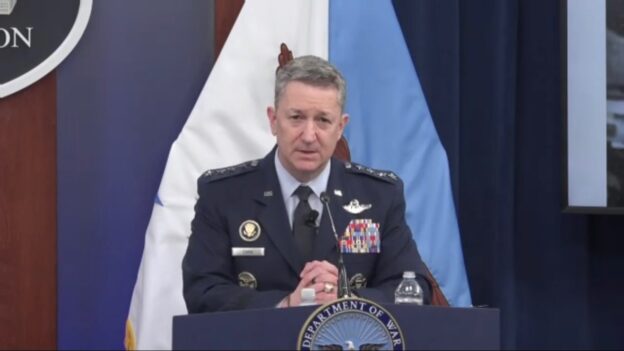
Speaking at the House Republican conference in Doral, Florida, President Donald Trump suggested the campaign against Iran might conclude relatively quickly, saying “We will ensure the routes.” The President later warned that any attempt by Iran to halt oil flows through the Strait of Hormuz would trigger a far stronger response. “If Iran does anything that stops the flow of Oil within the Strait of Hormuz, they will be hit by the United States of America twenty times harder than they have been hit thus far.” This was reiterated by General Caine when asked at a press conference Tuesday morning, when it was safe to do so, the U.S. would ensure safe passage. Development Finance Corporation CEO Ben Black, said, the “DFC is here to provide support and stability in order to ensure there are minimal disruptions to operations and markets,” and “DFC’s Political Risk Insurance and Guaranty products will help ensure commerce, capital, and energy can operate at capacity during the ongoing conflict.”

Battlefield Signals and the Oil Market

Defense officials say U.S. forces have struck more than 5,000 targets inside Iran, focusing primarily on missile systems, defense industrial manufacture, drone infrastructure, and nuclear-related facilities.The nuclear dimension of the conflict also remains central to Washington’s strategic rationale. During negotiations before the escalation, U.S. envoy Steve Witkoff said Iranian negotiators acknowledged that Iran possessed enough highly enriched uranium that, if further enriched to weapons-grade levels, could theoretically produce material for roughly eleven nuclear weapons.

Despite the numbers, and official statements daily that today is the biggest day, there should be caution that the effectiveness of the strikes will take time to fully evaluate. Analysts at the National Geospatial-Intelligence Agency typically require about a week to produce a comprehensive battle-damage assessment, meaning early claims about the impact of strikes remain preliminary. It could take a week from the final hit to know with certainty that shipping can be secured.

Mines, Missiles and Maritime Pressure

New battlefield analysis suggests Iran has explored mining the Strait of Hormuz as a way to disrupt maritime traffic. Yet mining the strait would also threaten Iran’s own exports.

U.S. Central Command reported that American forces destroyed 16 Iranian vessels capable of laying naval mines near the Strait of Hormuz, part of a broader Iranian effort to threaten maritime traffic and impose economic costs on Gulf states and the United States. Iran has historically used naval mines to threaten shipping lanes in the Persian Gulf, and even limited mining could halt commercial traffic because insurers and shipping companies typically suspend transit until mines are cleared. Iran had somewhere between 3000-5000 sea mines stockpiled, predominantly Russian and Chinese made.

Commercial maritime tracking indicates that traffic from vessels associated with Iran’s so-called “ghost fleet” has already dropped sharply in recent days.

Kharg Island and the Oil Lever

One strategic option discussed in Washington involves Iran’s primary export terminal at Kharg Island. The island handles the majority of Iran’s oil exports and represents the central node of Tehran’s energy revenue. President Trump has reportedly suggested the possibility of deploying U.S. forces. Troops could try to neutralize or seize the facility in an operation that could effectively strangle Iran’s oil exports without attempting to occupy Iranian territory.

Such a move would represent a major escalation, but it illustrates how maritime dominance alone can exert enormous economic pressure on an oil-exporting state. Even without physically closing the Strait of Hormuz, controlling the skies and having maritime control can impose similar effects, making such a plan less likely.

The challenge is that Iranian missile batteries, drones, and naval patrol craft positioned along the coast still threaten vessels passing through the narrow corridor. Until every drone is neutralized, insurers and shippers will remain shy of using the waterway.

Kurdish Regions and Internal Pressure

Western Iran may also become an arena for internal instability as the conflict continues. Several provinces along Iran’s border with Iraq including Kurdistan, Kermanshah, and Ilam have seen strikes targeting internal security forces and police facilities.

Reports indicate the Trump administration has encouraged Kurdish leaders in the region to challenge Tehran’s authority, raising the possibility that Kurdish groups could open a second internal pressure point against the Iranian government.

Analysts say Kurdish leaders seem prepared to act, but require external encouragement matched by sustained international support, while a Kurdish uprising could weaken Tehran’s internal control but would also carry risks of regional fragmentation.

Regional Escalation

The conflict widened as Iran and Hezbollah increased attacks on Israel. Israeli officials say that Iranian and Hezbollah forces launched coordinated missile barrages using cluster-munition warheads, weapons that disperse dozens of smaller bomblets over a wide area after a missile detonates at altitude. Military assessments indicate that a significant share of Iranian missiles fired during the conflict have carried cluster submunitions, complicating air-defense interception and increasing the risk to civilians. The coordinated use of such weapons widened the conflict into a broader regional confrontation involving Tehran’s proxy network.

Diplomacy and Intelligence

The war has also raised questions about Russian involvement, but Russian officials have denied sharing intelligence with Iran during the conflict. Asked whether Washington could rely on those assurances, U.S. envoy Steve Witkoff responded cautiously. “I’m not an intelligence officer, so I can’t tell you,” Witkoff said. “Let’s hope that they’re not sharing.”

Markets Waiting for the Next Signal

For traders, the decisive variable remains time. If the conflict proves short and shipping continues to move through the Strait of Hormuz, the geopolitical premium currently embedded in oil prices could fade quickly. The markets are the factor most carefully managed by the Trump administration, one can be sure it is closely watched to ensure stability, consumer confidence in the administration and at the pump, while economic statecraft combines with warfare.

The administration has a timeline on trust, if the war expands into a prolonged struggle over maritime control, insurance markets, and energy infrastructure, oil traders will begin pricing in a reality. This could be a much deeper disruption to global supply. With nearly one-fifth of the world’s oil moving through a corridor only a few miles wide, even the perception of danger in the Strait of Hormuz has proven to move markets and shape the global economy.

In modern energy markets, strategy and price now move together: every missile launch, naval maneuver, or diplomatic signal becomes another data point in the world’s attempt to predict the future. In modern warfare, the balance of power is an act of economic statecraft as much as surgical strikes.

John Major Energy-Bills initiative: Headache or Opportunity for Osborne?

A bold suggestion by former Tory Leader Sir John Major can either be a headache or an opportunity for Chancellor George Osborne.  The challenge of popular policy thrown by former conservative Prime Minister  to Chancellor  Osborne  could turn into his advantage by subtle pressure on energy companies which could increase David Cameron’s government popularity.

Continue reading

Cameron Tells Jewish Community Leaders: let EU Iran sanctions do the Job

As the European Union agreed today to step up the pressure on Iran through another ubstantial package of sanctions, the Prime Minister David Cameron will tonight tell an influential gathering of the Jewish community that we need the courage to give these sanctions time to work while making clear that in the long term, if Iran does not address the concerns of the international community, nothing is off the table.

Continue reading

Coalition Energy Policy That Makes Little Sense

A government draft energy bill published today, lays out plans aimed to guarantee prices for low-carbon electricity and pay producers for providing back-up supply when wind power falls short, according to the Department of Energy and Climate Change. DECC. It’s aimed at securing commitments from utilities to fund new atomic reactors and clean-power projects, curbing reliance on gas-fed plants. As the plan invites private sector to invest in building a new generation of nuclear power plants.

Continue reading

The anti-Shale gas Fracking Green Freaks Should be Ignored

While the price of natural gas has been its lowest for many years in North America, thanks to technology known as fracking, which extracts gas trapped deep in the rocks, British energy consumers are paying one of the highest prices in Europe thanks to the madness of coalition government obsession with green energy targets that makes little economic sense. The news that Shale gas fracking operations should be allowed to resume in the Britain as long as “robust” measures are adopted to safeguard against future risks according to recommendation by an independent report had two contrasting receptions in two different camps.

Continue reading