After a bruising week in Westminster, the Prime Minister found his most honest audience in a Belfast nursery.
By Adel Darwish
A prime minister who finds himself aligned with public opinion during a foreign crisis might reasonably expect a little political relief. Keir Starmer’s cautious distancing from the American strikes on Iran reflects the instinct of most British voters, who remain wary of another Middle Eastern war. Yet even this rare moment of alignment has done little to improve the government’s political fortunes.
The latest polling suggests a remarkably stagnant landscape. A seven-poll rolling average published this week places Reform UK on 27.4 per cent, Labour on 19.4, the Conservatives on 17.9, the Greens on 14.9, and the Liberal Democrats on 11.9. Despite rising oil prices and the geopolitical tensions surrounding the Iran conflict, there has been no sudden movement in public opinion. Labour has even edged slightly upward over the week. If higher petrol prices were provoking a backlash against the government, we would expect the opposite: a sharp fall in Labour support and a surge for opposition parties. Instead, the numbers suggest voters currently blame global events rather than domestic policy.
That did not spare Starmer a bruising encounter in the Commons. At Wednesday’s Prime Minister’s Questions, Kemi Badenoch used all six of her allotted questions to focus on fuel prices and the looming prospect of higher fuel duty. With Brent crude fluctuating sharply in response to Middle East tensions, petrol and diesel costs are once again creeping upward. For millions of people outside London, Badenoch argued, driving is not a luxury but a necessity — especially for tradesmen, delivery drivers and small businesses whose vans keep the economy moving.
Starmer attempted to deflect the pressure by attacking the opposition’s stance on Iran, accusing Badenoch of shifting positions and suggesting she had previously called for Britain to support American strikes. The exchange grew increasingly heated. At one point the Speaker intervened to remind the Prime Minister that his task was to answer questions rather than ask them of the Leader of the Opposition.
Fuel prices are not a trivial political issue. Rising oil costs ripple quickly through the economy: transport, food distribution, and ultimately inflation itself. Should the surge in energy prices persist, the Bank of England may hesitate before cutting interest rates, delaying the relief many mortgage holders had hoped for this spring. It is precisely this chain reaction that makes petrol prices such a sensitive political subject.
The government’s response has been to summon oil company representatives to Downing Street. Chancellor Rachel Reeves and Energy Secretary Ed Miliband called the industry in for talks at No.11, warning them against “profiteering” by raising prices at the pump. The Prime Minister’s spokesman said ministers were monitoring the situation closely and hinted that companies could face referral to the competition authorities if evidence of manipulation emerged.
The meeting itself became contentious. Retailers accused ministers of using “inflammatory language” about alleged profiteering, warning that it had led to members of the public abusing staff at petrol stations. Some companies even threatened to boycott the talks unless the government agreed that the opening of the meeting would not be filmed by television cameras.
Yet the week’s most awkward development for Downing Street came not from global oil markets but from Westminster itself. Documents released under parliamentary pressure revealed that officials had warned about the reputational risks of appointing Peter Mandelson as Britain’s ambassador to Washington. Mandelson is no stranger to controversy. During Tony Blair’s government he was twice forced to resign from cabinet — first in 1998 after failing to disclose a £373,000 loan from fellow minister Geoffrey Robinson, and again in 2001 after contacting the Home Office about the passport application of the wealthy Hinduja brothers. His post as ambassador quickly became politically untenable once questions resurfaced about his past association with the convicted sex offender Jeffrey Epstein, an association Mandelson had earlier sought to minimise. Despite those concerns, the appointment went ahead. The saga took another turn when it emerged that Mandelson had sought compensation reportedly exceeding £500,000, before eventually agreeing to a settlement of £75,000 — a figure Downing Street insists represented “good value for money” compared with the potential cost of litigation.
The episode culminated in an unusual moment of contrition. On Thursday, the Prime Minister acknowledged that appointing Mandelson had been a mistake and apologised to victims connected to the Epstein scandal. It was a rare public admission of error from a sitting prime minister, though whether it draws a line under the affair remains to be seen.
At Friday’s lobby briefing, Downing Street declined to elaborate on what lessons the Prime Minister had drawn from the episode, with the spokesman cautioning journalists against speculation until the remaining documents are released.
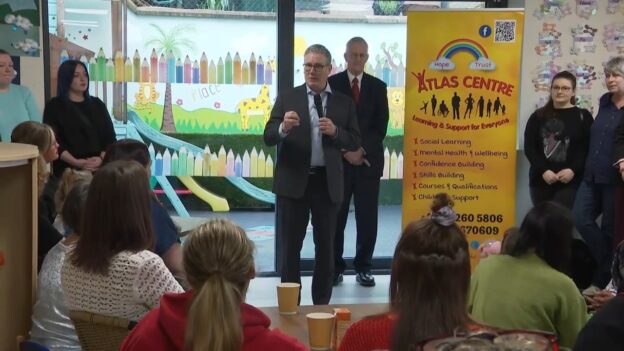
By then, Starmer had already left Westminster for Belfast, that familiar corner of the kingdom where ministers sometimes find themselves dispatched when the political temperature rises in London. Hilary Benn, the Northern Ireland Secretary, stood dutifully beside him like a silent chaperone. The once formidable Downing Street spin machine of the Blair years, when communications were run by Alastair Campbell with Mandelson advising discreetly in the background, might have handled the optics differently. This week the Prime Minister’s team made a simpler logistical decision: Parliament lobby reporters were left behind and Starmer took questions only from local media in an off-camera informal huddle. After a bruising week in Parliament, the controlled environment was perhaps understandable. A nursery classroom, after all, offers a famously undemanding audience — one unlikely to ask awkward questions about fuel duty, oil prices, or the wisdom of appointing Peter Mandelson.
He took refuge in Belfast, well away from Westminster’s turbulence, and, not insignificantly, from the lobby journalists whose questions had been sharpening throughout the week. There, during a visit to a nursery school, he acknowledged he had made a mistake in appointing Mandelson and apologised to Epstein’s victims. Whether the wider public will be quite so forgiving remains uncertain. While he spoke, several toddlers began crying and fidgeting. “I know… I’m nearly finished,” he reassured them. Westminster instincts, including heckling, it seems, can develop remarkably early.