As Labour chased Reform voters, the Greens patched together a coalition on the left — and breached a seat once thought watertight. Adel Darwish analyses the Gorton & Denton By-Election.
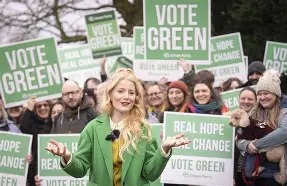
Green’s MP for Gorton&Denton, plumber Hannah Denton
The headline numbers were stark. Hannah Spencer of the Green Party of England and Wales won Gorton and Denton seat with 40.7 per cent of the vote — a swing that carved out 26.7 per cent from Labour’s previous share. Reform came second on 28.7 per cent, some 4,500 votes behind. Labour slumped to third with 25.4 per cent, nearly 6,000 votes adrift of the winner. The Conservatives trailed in fourth and lost their deposit, bleeding support to Reform. More telling still is the combined vote of the three traditional Westminster parties — barely 29 per cent between them. This is not an isolated aberration but part of a longer trajectory that began with the Brexit referendum, when distrust of the political establishment first broke through the surface of British electoral behaviour. A decade on, that distrust has not dissipated; it has diversified. Voters are no longer merely alternating between two governing parties. They are actively seeking alternatives to both.
In a constituency long regarded as a Labour stronghold — one of those seats entered in red ink before a campaign even begins — the symbolism is devastating. For almost 100 years the seat, in its various boundary incarnations, had returned a Labour member. It was woven into the party’s industrial north narrative — mill towns, municipal socialism, trade union roots. That continuity has now been severed, not by the Conservatives, but by a party that until recently struggled to break through Westminster’s first-past-the-post barrier.
The Greens’ victory is historic for another reason: it was only their first Westminster by-election win. Yet it was not even among their top hundred priority battlegrounds. It reportedly sat at 127 on their “target seat” list — a ranking system small parties use to allocate limited resources to constituencies deemed realistically winnable. For readers unfamiliar with the mechanics: minor parties compile internal hierarchies of seats based on past vote share, demographic shifts and organisational presence. Money, activists and leadership visits are funnelled to the top tranche. A win outside that tier suggests either extraordinary local momentum or systemic weakness in the dominant party. Here, plainly, it was both.
Within Labour, the muttering has grown louder. Some MPs whisper to journalists in corridors; others air their concerns openly on radio and television. The charge is blunt: the problem is the leader. They recall how Starmer and the party’s National Executive blocked Greater Manchester’s popular mayor, Andy Burnham, from standing. The implication is clear — a locally rooted, high-profile Labour figure might have stemmed the tide. Instead, the party machine imposed caution where charisma was needed. For a leader already battered by poor polling and a faltering narrative on the economy, this mini-earthquake compounds the sense of drift.
Yet beyond the immediate party calculus lies something more troubling for British democracy itself. Two strata of voters deserve close attention: Muslim voters, particularly of South Asian heritage, and younger voters — including first-time 18–19-year-olds and the substantial student population in the area.
At first glance, this was a protest vote about living standards. The acceptance speech and subsequent press conference by Ms Spencer emphasised bread-and-butter themes: services, wages, fairness, and making work pay. A local plumber and plasterer by background — white, working class, and plainly spoken — she projected authenticity. But here lies the paradox. The white working class who prioritise precisely those issues did not vote Greens in large numbers. They moved to Reform, whose agenda speaks more directly to their anxieties about jobs, wages, immigration and public services.
Reform’s 28.7 per cent suggests a coherent transfer from Conservative and disaffected Labour voters who see economic strain as intertwined with immigration pressures — a subject the Greens largely sidestepped and Labour downplayed. Reform’s disappointment will be that second place is cold comfort, yet the numbers show a consolidated base among traditional white working-class voters.
The Greens’ surge appears instead to have been powered by a coalition of Muslim voters and younger, university-educated electors. The party’s literature was carefully segmented by language and theme. Leaflets in Urdu and Punjabi addressed Muslim voters and highlighted grievances facing Muslims in India, invoking allegations of Hindu nationalism; Gaza and the grievances of fellow Muslims in another land were also featured prominently in this material. English-language leaflets, by contrast, foregrounded Gaza in a broader humanitarian frame and criticised Conservative and Labour policy in the Middle East. For students and younger voters, the message returned to climate, redistribution and social justice, with Gaza again serving as an emotional rallying point.
This multi-track messaging raises uncomfortable questions about whether voters were being addressed as citizens sharing a common civic debate, or as discrete identity blocs receiving tailored narratives calibrated to their particular sensitivities.
First, the use of foreign-language leaflets. In practical terms, community outreach in voters’ preferred languages is hardly unprecedented; parties of all stripes have done so in diverse constituencies. Yet it also underscores a democratic concern: segments of the electorate may be engaging with politics through issue-specific or identity-based lenses rather than through a shared civic discourse. A national democracy depends on common reference points. When campaigns fragment messaging by ethnicity and language, the risk is political balkanisation.
Second, the ideological contradictions are more profound than polite commentary suggests. Some of the Greens’ flagship policies — liberalisation of drug laws, expansive LGBT education in schools, socially progressive curricula, and a broad secular social platform — sit uneasily, and in some cases directly at odds, with the traditional religious and cultural values held by many Muslim families in the constituency.
It may be that, in this election, foreign policy grievances and perceived injustices abroad outweighed domestic social policy differences. But such alliances are transactional by nature and rarely durable. They depend on the continued primacy of an external cause over internal contradictions.
There is also a more delicate question concerning language and integration. When campaign material is issued primarily in languages other than English, it is legitimate to ask whether some voters may not be fully exposed to the wider spectrum of domestic policy debates shaping British society — debates that will inevitably affect their English-speaking children in schools, universities and workplaces. A democratic choice is most meaningful when it is made with full awareness of the broader policy platform, not solely on a subset of emotionally resonant issues.
For younger voters, particularly students, Gaza appears to have been a galvanising issue. Yet foreign policy was scarcely central to the daily concerns of older, economically pressed residents. The divergence between the priorities of students and those of long-standing working-class families reveals a constituency split along generational as well as ethnic lines.
For Reform, the lesson is equally sobering. Their candidate, reportedly an academic rather than a locally embedded figure, may have lacked the personal resonance needed in a by-election where retail politics still matters. More fundamentally, Reform faces a structural dilemma. To broaden its appeal among ethnic minority and younger voters, it would need to soften elements of its platform — particularly on immigration and cultural issues. But doing so risks alienating the white working-class voters who form its current backbone. Electoral arithmetic can be merciless.
For Labour, the strategic quandary is deeper still. If Muslim and younger voters drift leftwards towards the Greens on foreign policy and identity issues, while white working-class voters defect to Reform over economic and immigration concerns, the party’s traditional coalition fractures. Reassembling it requires more than managerial competence; it demands a narrative that bridges class, culture and generational divides. At present, critics argue, that narrative is absent.
Thus the by-election becomes more than a local protest. It signals a fragmentation of the political landscape in which the two historic governing parties command barely a third of the vote combined. The Greens celebrate a breakthrough; Reform consolidates insurgency status; Labour questions its leadership; the Conservatives slide further into irrelevance in a seat they once contested seriously.
Five weeks running, each worse than the last, is not merely bad luck. It suggests structural weakness. Whether Sir Keir can arrest that trajectory — or whether internal pressure will grow for change — remains to be seen. But Gorton and Denton has delivered a verdict that Westminster cannot easily ignore: the electorate is restless, divided, and increasingly willing to experiment.
In politics, by-elections are often dismissed as mid-term tantrums. Sometimes they are. But occasionally they are tremors before a larger shift. This one feels less like a tantrum and more like a warning.
End- © 2026 Adel Darwish. All rights reserved. Quotation permitted only with clear attribution to the author